
“We are not so much human beings as we are human becomings.” (Friedrich Nietzsche)
An explicit goal of the Innovation Fellowship is to create a purposeful and intentional space for the personal and professional development of young people working in civil society organisations. It is designed to provide the Fellows with knowledge and skills which would enable them to identify opportunities to generate new ideas, approaches and solutions to existing organisational challenges and to explore the implications and complexity of facilitating change. The Fellowship is a platform for the Fellows to engage their creativity, design innovative approaches and implement them within their organisations
Coaching is all about learning
Learning is the key driver of the Innovation Fellowship. Learning occurs in different contexts – during the Immersions and in between them, when the Fellows work on assignments to bring their exploration of an innovation question into their own organisations.
A key element of the learning programme is the provision of coaching and mentoring, which support the Fellows on their journey of discovery. Fellows receive individual coaching, are coached as pairs or trios and have their coach support and mentor them in structured interactions with their own organisations.
The theoretical model underpinning the coaching approach
From the start of second cohort of Fellows in 2019, the Ontological Coaching framework has been used, supported by a Lead Coach and five coaches, all of whom are trained and accredited ontological coaches. In addition, the key text book, The Innovator’s Way, provides an ontological model for innovation.
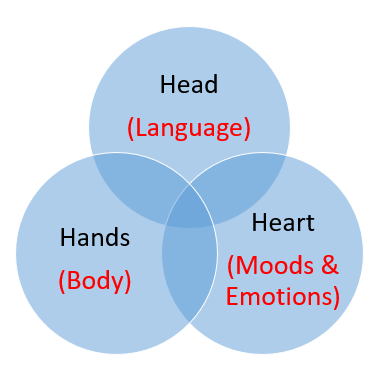
The ontological approach is a good fit for the Fellowship. Ontological coaching is not psychologically based, but rather it is an existentially focused model, concerned with the human way of being, made up of the way in which people use Language, the Moods and Emotions, which are predispositions for action, and their somatic experiences of their Body. As the diagram below illustrates, there is alignment between the Ontological approach and the Head, Hands, Heart focus of the Fellowship.
The Ontological approach works with Language (which is used to think, speak and listen), Moods and Emotions (which is what is happening in the human heart) and the Body (which is related to the concept of Hands).
Ontological Coaching is characterised by coaching to Way of Being. Our Way of Being is the underlying driver of communication and behaviour. Our perceptions and attitudes, many of which may be deep seated and out of awareness, exist in our Way of Being. Change in these perceptions and attitudes can result in the removal of significant barriers to learning, and the spontaneous development of more effective patterns of communication and behaviour.
Effectiveness in personal and professional life, and the quality of our existence, is indelibly shaped by Way of Being.
Way of Being is a regarded as a dynamic interrelationship between three areas of human existence – language, emotions and body. Coaching in all three areas of language, emotions and body has the potential to be transformative, for it can generate profound learning and deep constructive change. (Alan Sieler, Newfield Institute, which is a major international ontological training body.)
The difference between coaching and mentoring
In essence, coaching is a non-directive, non-advisory facilitated process of learning in which coachees learn new ways of observing themselves, others and the world. Skilful questioning by the coach opens new avenues for exploring the self and others. In this modern world of perpetual, often disruptive change, effective living, and indeed personal and professional success, depends on the capacity to observe, reflect and learn.
This includes accepting that multiple perspectives are vital in approaching complex problems. Learning to invite and welcome different opinions, approaches and theories creates the possibility of innovative and sustainable solutions that are acceptable to diverse groups, even those with widely diverging theoretical or ideological starting points. And key to this new way of being is the capacity to distinguish between fact and opinion – to see the distinctions between true assertions and subjective assessments, which frequently masquerade as facts, truths and the “way things are”.
Using these new distinctions enables the coachee to become more conscious and intentional and to develop clearer and more effective ways of being in the world. The focus is on learning and on learning about oneself as a learner, identifying habitual barriers, which are often long-held negative self-assessments, and enrolling new language and moods to become a more effective observer and learner. The work of the coach is to provide a safe relationship and to introduce challenging conversations in which the coachee becomes able to shift from a fixed mind set to a growth mind set, which establishes the foundation for compassionate observation, continuous learning and an expansion of consciousness.
Mentoring is also a learning and development relationship, but one in which a more experienced or more knowledgeable person actively helps to guide, teach and support an individual or team with less experience or knowledge. In some ways the mentor can be seen as a consultant, who brings a particular skill and knowledge set to the relationship, and who provides advice, information and other forms of explicit support. The mentor introduces skills, knowledge and expertise to those who are mentored and the focus is on actively assisting them to learn how to do their work or run their team, department or organisation more effectively
Coaching and mentoring on the Innovation Fellowship
Part of the design of the Innovation Fellowship includes coaching and mentoring of both the individual fellows and their senior manager or management team.
Individual coaching
The Fellows receive 5 individual one-to-one coaching sessions between the Immersions This creates an opportunity for personal reflection on the learning, the group process and the innovation question each Fellow seeks to answer. The coach may offer practices to the Fellows in order to deepen and consolidate their learning about themselves, others and world around them. Coaching sessions are confidential and a safe space is created for Fellows to explore their own concerns. No reports are compiled on the content of coaching sessions.
Fellow-Fellow Coaching
After each Immersion the coach works with both Fellows from each organisation, and sometimes a single Fellow from another organisation is included. Careful attention is paid to the quality of the relationships between Fellows, which leads to closer alignment on the innovation challenge.
There is a focus on reflecting on the experience of each Immersion, progress on refining and applying the innovation question, and preparation for the 3 Organisational Mentoring sessions.
Organisational Mentoring
There are 3 Organisational Mentoring sessions which take place after each Immersion. In this work, the coach acts as a mentor, a role more aligned to the concept of consulting rather than coaching.
The purpose of the Organisational Mentoring is to facilitate the embedding of the Fellows’ innovation work in the life of their organisations through developing a shared understanding of and commitment to the programme and to the innovation proposed.
Key distinctions
There are a number of key distinctions which are offered to the Fellows in the coaching process:
- Basic Linguistic Acts, which illustrate how our speaking creates our reality. This includes the distinction between assertions and assessments, the power of declarations, and the importance of offers and promises.
- Self-observation, which brings into awareness Fellows’ language, moods and somatic responses and enables Fellows to shift from unconscious reactivity to engaged responsiveness.
- Enemies and Allies of Learning, which introduces learning as a practice that we can enhance by shifting unintentional blockages to learning and embracing humility, courage and shifting negative moods. Allies of learning include awe and wonder and can be leveraged to maximise learning opportunities.
- Noting that our action is influenced by emotions and moods, the Moods Framework supports Fellows to develop practices that identify unresourceful moods and provide clues on how to shift into more effective moods to take care of concerns.
- The Promise Cycle, which focuses on how language generates reality and sparks action through more explicit, detailed requests and the responsibility associated with making offers and promises, which form the basis of accountability.