
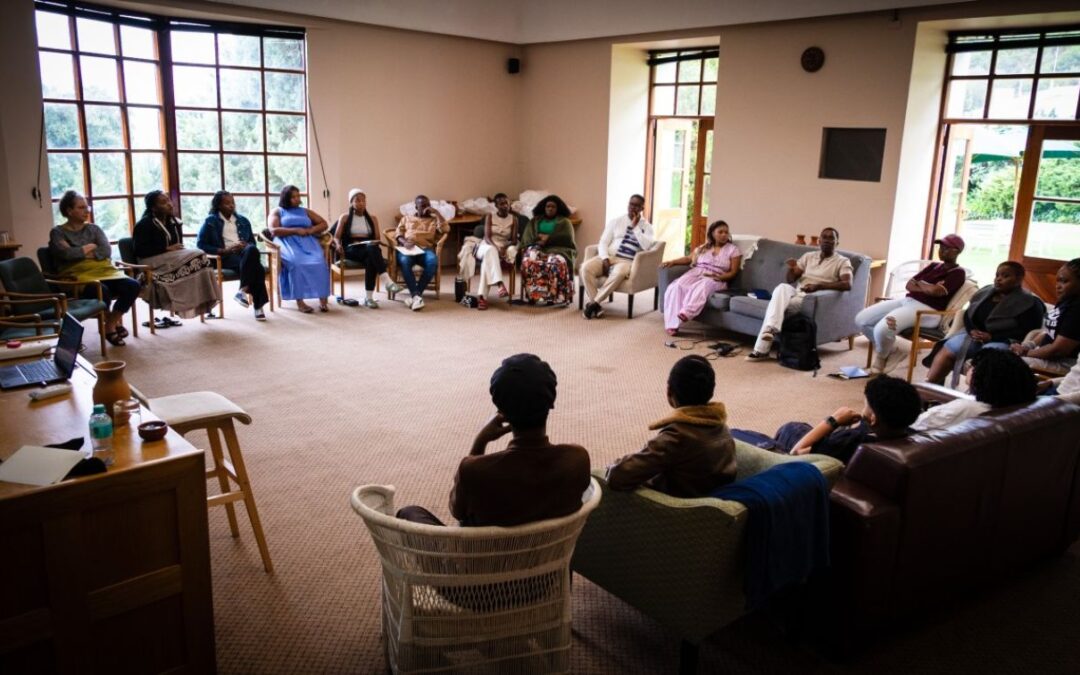
Coming up to the home stretch of the DGMT Innovation Fellowship’s 12-month programme, Cohort 8 were much in need of a moment to pause, to slow down and to reflect on what they are doing and what they have learned so far.
Posing a difficult question to an organisation means convincing others to recognise a pain point in their system that they may be unwilling or unable to face. Persuading them to participate in changing that is political.
An organisation can be a difficult audience for a message like this, so used to making calls to action to others that they perhaps don’t see that they are the ones needing to change. In that same audience sit organisational leaders wearing many hats as they face not only the pressure of deadlines and the burden of collecting evidence of delivery and impact but also of mobilising further resources to continue their organisations’ valuable work. In Immersion 3 Fellows really came to see the depth and breadth of their organisational leaders’ interests, their enormous responsibilities and the burden on them as humans. And from the Fellows’ perspective it’s not only challenging to convince leaders but also to include other staff members in recognising the need for a change. It somehow lacks legitimacy and urgency to them, and because it feels like a foreign thing and a burden, they lack the incentive to listen and to participate.
Fellows learned that seeking out the root causes of a problem must start with those people who are most affected by the problem. They are the experts, and they are the most invested in the problem, so it is critical to listen to them. Innovation is a test of your ability to bring people along with you in finding a solution; it’s not just a genius idea you have on your own. Can you convince people? Can you get them to change their thinking? Can you get them on board? Your strength as a conversant is key to this. Everything about communicating a message of change happens in conversation and that conversation can happen anywhere, anytime, with any number of people, not just in formal meetings and workshop spaces.
Creating the best conditions for a conversation that includes all these different audiences is a practice. There are concepts, skills and tools that can help you do this well, but in the end each one must try and fail and try again and again, each time getting better at both listening and sharing, and learning from mistakes even while lamenting them or boiling with frustration. Having a talking or a thinking partner is supportive in this struggle. Whether it be your fellow Fellow, the partner who is going through all of this with you, or your coach who is helping you reflect on your way of being, your learning group who are there to show you other ways of working things out or your Cohort who are there alongside you to play, laugh, comfort you, remind you of your best self, intrigue you, affirm you and remind you to slow down, to rest, to take a break, to relax, to breathe, to appreciate the small things and to keep going, their support is fuel.
Being in nature, taking part in experiential exercises, resting, taking time to be alone, getting involved in all kinds of conversations, listening to music, singing, dancing, playing childhood games, and doing arts and crafts together stimulated everyone’s creativity during Immersion 3 and this fed the Fellows’ energy. They were struck by the importance of energy as an organisational resource as valuable as funds or time in the living system of an organisation. Much of our focus in organisational life is on productivity and productivity takes energy. Where does that energy come from? Can we give up productivity and the single-minded use of our left brain for logical, analytical and structured step-by-step tasks without negotiation? This cohort found that by fully embracing the flow of the week, they could. This Fellowship encourages people to envision with their right brain, that part responsible for creativity, intuition, and holistic processing, which focuses on the big picture, at interpreting context, at recognising and reading faces, and processing non-verbal information. This is what we believe fuels innovation.
In daily organisational life where our donor commitments generate an unrealistically high volume and intensity of work, we can’t slow down and replenish our own energies, or easily make a switch to creative thinking. How then do we generate that momentum for others? If we can’t slow down, how do we expect others to slow down? Creativity needs a slow, free, playful way of working to thrive.
This cohort isn’t finished yet: one last assignment and then a closing session where we get to hear the fruits of their thinking and their labours. Will they be able to answer some of these questions? Will some of their innovative ideas make it past the drawing board and into the world?
Watch this space!