

If you were to liken Xolile Zondi’s career to a microscope, you could say that she has used several different lenses over time – but the subject, or specimen, has always been the same. The ‘subject’ of her lifework has been the upliftment of young people across South Africa. The ‘lenses’ through which she has approached this subject have been educational, academic, managerial and practical.
The DGMT Innovation Fellowship (‘the Fellowship’) has helped her to define more clearly the type of ‘lens’ she wants to use. Now, as the executive director of Luqa Development Consulting, Xolile reflects back on her path and the role that the Fellowship played in it.
The educational lens: a formative start in education
Xolile grew up in Umlazi, “a very big township in the South of Durban,” where the importance of education was drummed into her from a young age. “Education really changed my father’s family’s circumstances,” explains Xolile, “and so he invested – both financially and non-financially – in our education.” Xolile did not go to school in Umlazi, but commuted every day to Queensburgh Girls’ High school. The school was relatively well-resourced compared to those in Umlazi – and this fact was to have future ramifications on Xolile’s dedication to youth upliftment.
Encouraged by her guidance counsellor, Xolile was granted the Gallagher Foundation scholarship to the University of Cape Town (UCT). “Academically, I was in the top ten of my school – but at university, I was a small fish in a very big pond,” she explains. “I also noticed that, because I went to that girls’ school, I was able to navigate the social setting more confidently than other people from my background. This difference highlighted the jarring inequality that someone’s schooling can create.” This made Xolile determined to be part of the solution.
Whilst at UCT, Xolile and other students from Durban established the Umlazi Mentor and Tutor Initiative. During holidays, they would return to Umlazi and provide support to budding students. “It was here,” says Xolile, “that I really saw the information gap between high school and university – and I wanted to help close this gap.”
The academic lens: the power of research to change policy
Back on campus, Xolile was keen to combine her academics with her social justice goals. She took what she learnt about social justice theory in the lecture halls out to people on the ground, and she wanted to find out what it meant to them. Combining these two spheres – the theory and the practical – for the development of young people became her goal.
She completed a Bachelor Social Science Honours focusing on Public Policy at UCT together with a Certificate in Service, Citizenship and Social Justice. As part of this, she went out into communities to research how theories of public policy actually impacted people in their day-to-day lives. “Take theories of globalisation and privilege, for example,” says Xolile. “I wanted to know what this looked like for people on the ground. I was asking myself how these people could contribute to knowledge that could, in turn, be used to better their situation.”
The managerial lens
Xolile later went on to become Head of Programmes at the Solomon Mahlangu Freedom College Trust. Here, she led projects in which young South Africans visited areas in Tanzania where ANC members were in exile during apartheid. “This used the history and bravery of our country to deepen young people’s empathy and leadership,” explained Xolile.
From there, she started to move away from the ‘frontline’ of working with young people and closer to the decision making and strategic development spaces. She became a social investment analyst and then a client relationship manager at Tshikululu Social Investments. This involved working in education, creative arts and women’s empowerment – including a secondment to the Solidarity Fund’s humanitarian efforts. Although the work was highly impactful, Xolile started to consider connecting big systemic goals with the lived experience of young people in peri-urban and rural areas.
The practical lens (backed up by academic theory)
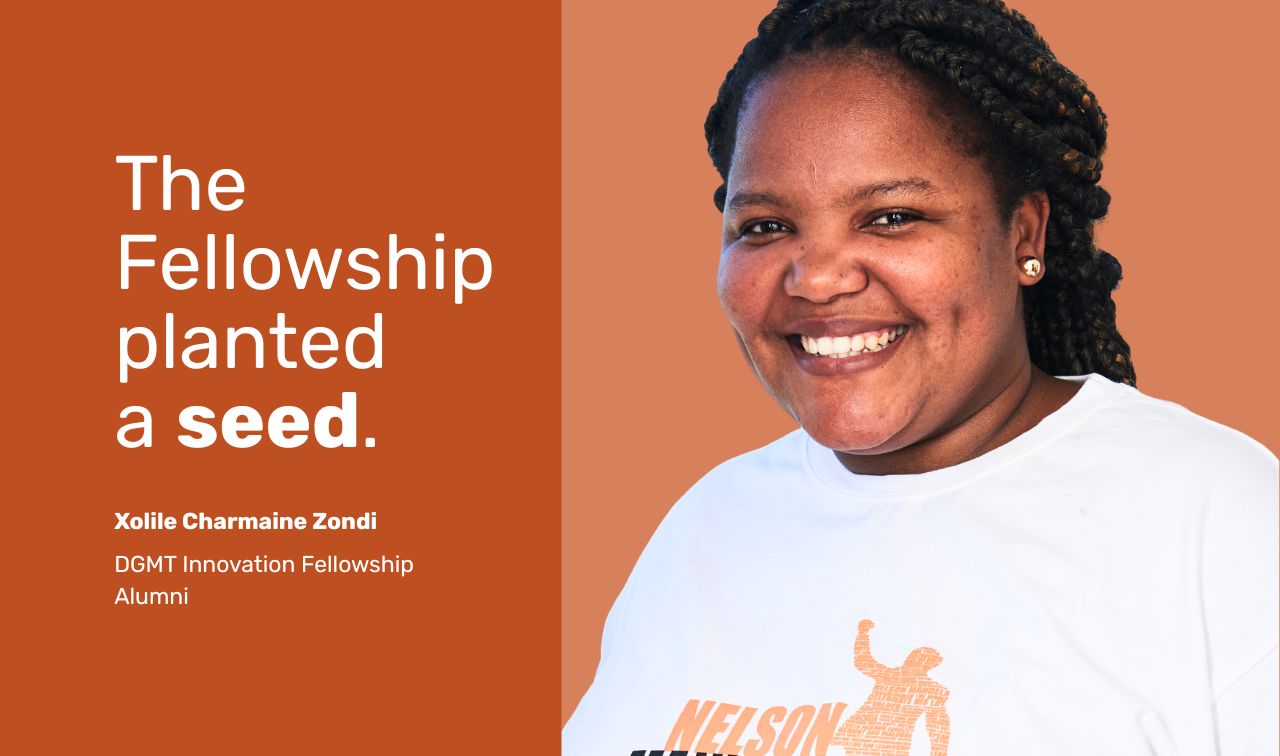
Whilst at Tshikululu Social Investments, Xolile was approached to enroll in the DGMT Innovation Fellowship. Here, her chosen approach to youth upliftment became clearer. “For me, the Fellowship planted a seed. It made me ask myself about my trajectory in the development sector. That seed just kept growing.” Surrounded by other young Fellows who were working on the ground, Xolile was further inspired to take her experience and knowledge and re-apply it to working directly with people on the ground.
Shortly after the Innovation Fellowship, Xolile took the role of CEO at enke: Make Your Mark, which supports young people to build pathways into employment and entrepreneurship.
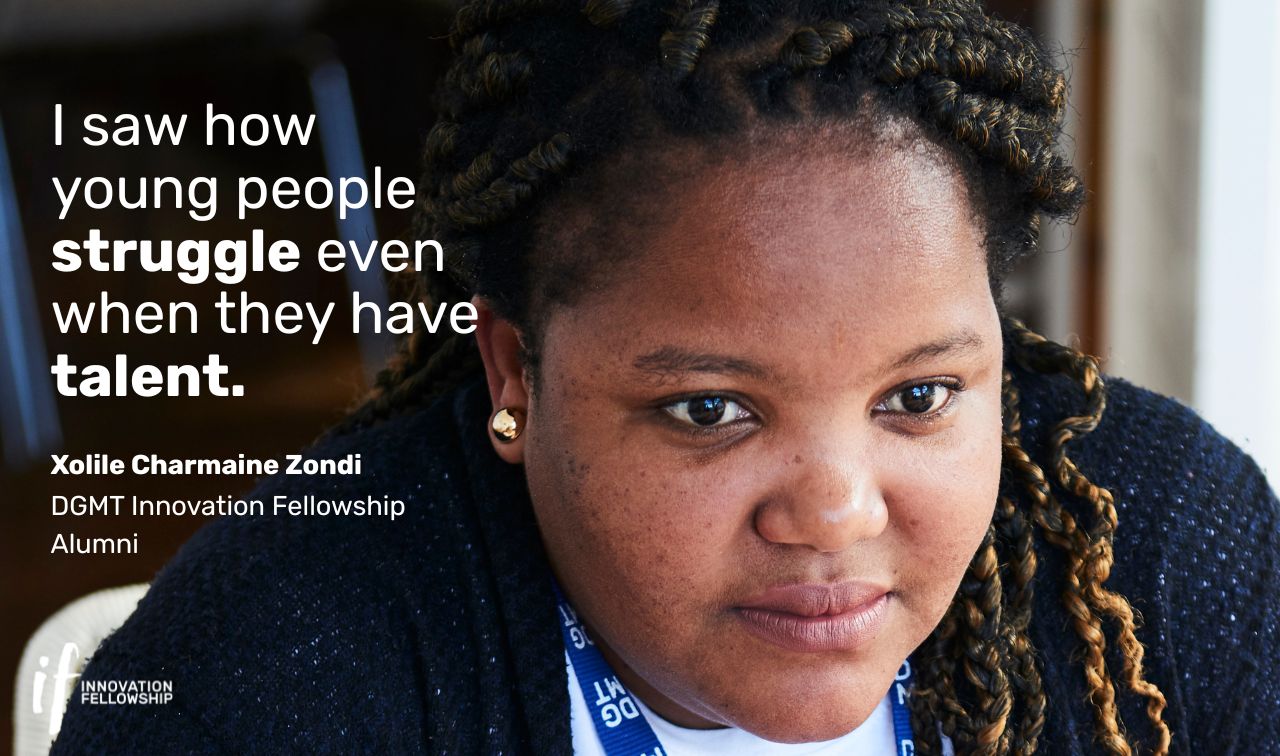
“I was fully back in the development space,” she says, “and I saw how young people struggle even when they have talent, because without the soft skills, they are not on an equal footing with their peers.” What they need, says Xolile, is leadership skills, personal mastery and emotional intelligence. Armed with these skills, “they can break family cycles and create generational wealth.” Recently, Xolile decided to transition to directorship of Luqa Development Consulting, which provides fundraising and strategic support to upcoming foundations.

The future lens: Alumni and legacy
Xolile still taps into the Fellowship Alumni network for support and collaboration. “It is not that we talk every day, but rather we reach out to each other to collaborate on projects or funding applications, or to share ideas. I really came to respect how they think.” This network helps her on her career journey.
Now, her aim is to leave a legacy of impact. Armed with her knowledge and experience, Xolile is working hard to make sure her work ultimately uplifts young people – ensuring that programmes support them in a genuine, deep and effective way.