
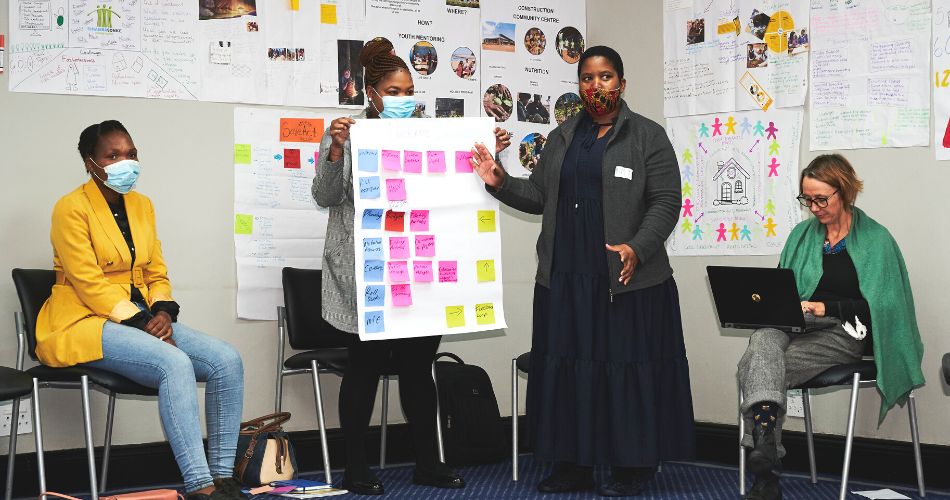
Nomthandazo Mbonambi is a powerhouse. As she speaks, Maya Angelou reading out her famous poem “Still I Rise” comes to mind. Life can throw hardship Nomthandazo’s way, but still, like dust, she will rise. But as the conversation goes on, it becomes clear that Nomthandazo wants to start rising in a different way – not alone, but rising with and alongside others. Exploring her approach to leadership as a young female leader is central to this exploration – and the DGMT Innovation Fellowship has played an important role.
A ‘one woman’ kind of person
“I used to be that ‘one woman’ kind of person – that’s how I worked,” says Nomthandazo.
A cockerel calls in the background of our call. Nomthandazo is walking across a field in rural Kwa-Zulu Natal. As Provincial Coordinator for SaveAct, she leads facilitators to support communities around financial literacy and Savings to ensure sustainable livelihoods and enterprises.
“I am a person who goes the extra mile,” she says. “This isn’t just about the job: it is about what I can do and what role I can play.” I imagine Nomthandazo striding across the field, with her team.
Deeply impacted by the manifestations of structural injustices around her, Nomthandazo jumped to take on work opportunities in civil society – working hard, and very determined. She rose rapidly from degree to postgraduate degree, and within SaveAct, she rose from Field Officer in 2013 up to Program Coordinator in 2017.

Attracted to independent communities
This ‘one woman’ independence seems to be a recurring theme for Nomthandazo. In 2012, she completed a placement with the Farmer’s Support Group, during which she “stayed with families, in their own homes,” to better understand their realities.
Reflecting on this time period, it was the independence of these communities that attracted and influenced Nomthandazo. “I was inspired by [the farmer communities’] ability to stand on their own two feet rather than depend on the government, or others, for help,” she says.
“People were talking positively about their savings … and how SaveAct empowered them.”
Indeed, it was among the farming group that she came to hear of SaveAct – the organisation that she would later work for.
A personal history of its own
Watching these rural communities standing up for themselves, perhaps it was herself that Nomthandazo saw in the reflection. Indeed, Nomthandazo comes from a family history of “picking themselves up.”
Nomthandazo grew up in a “politically volatile area” in Kwa-Zulu Natal. As a young child, her family had a substantial plot of land and lived comfortably. But when she was five years old, tragedy struck when disputes around land ownership took place.
“There was a political war,” she says. “We had to run away because of the killings that were taking place… there were guns everywhere, and we were in the bushes, and hiding in people’s homes, trying to survive.”
With no compensation, Nomthandazo’s family was forced to restart and rebuild in an urban area, with the entire family squashed into two rooms. “But we started picking up,” she says, “and we built a new house, and we grew up, and I went to school.
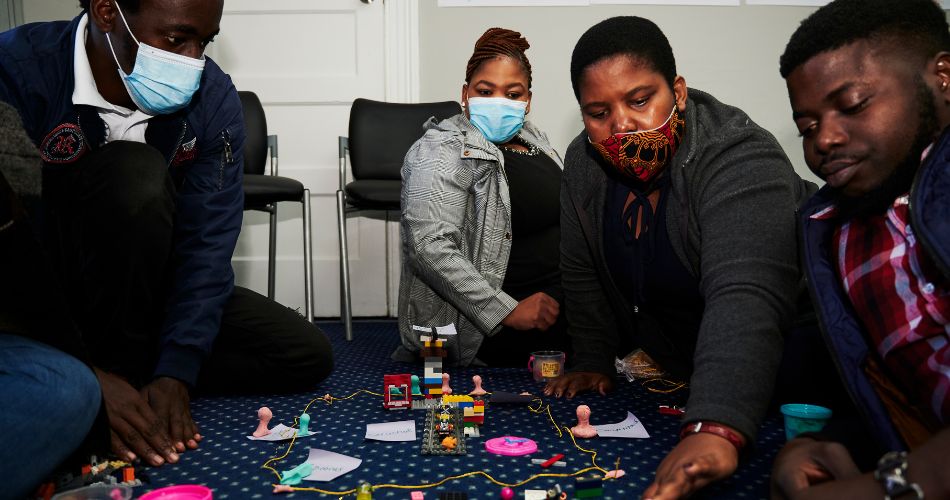
Leadership: creating space for reflection and mental health
Armed with resilience rooted in her family’s and community’s struggles, Nomthandazo was drawn towards leadership in her work.
“I’ve always seen how we struggled. I felt that something needs to be done, and I needed to be part of it.” Perhaps it was this single-minded dedication that led her to being a “one woman” leader.
Fast-forward to 2021, and Nomthandazo had begun a journey to reflect on, and shift, her “solo” approach to leading others. It was no longer about being ‘one woman,’ but about bringing a team with her – rising together.
This leadership journey took a route via the DGMT Innovation Fellowship. During this Fellowship, Nomthandazo was able to reconceptualise what it means to be a leader and a team-player. “When one is a good leader, the show must be able to go on without you but if everything falls apart when you are out of the picture (short or long term) that is a serious gap in leadership.” This has led her to more sustainable approaches to work, and the courage to involve herself in ensuring the sustainability of the organisation itself.
“I now see that leadership is about being strategic and understanding your team, your people … if someone is underperforming, we need to get to the root of why, and assist them.” This supportive approach to leadership has edges on team mental health, too – which includes the mental health of leaders themselves. And, seemingly conversely, more can be achieved as a team by taking the time to pause, reflect, zoom out, and reforge the path forward together. People can also underperform deliberately as a sign of undermining the leader. The leader should be able to tell the difference by applying all training and support needed.
“I’ve learned to slow down: to pause, stop and reflect on what is going right and what needs to be done differently so that the project can run smoothly and yields positive results,” Nomthandazo explains. “Because, before we can pour from our cups, we need to fill them up.”
This has also allowed her to pick up on nuances in her team and approach challenges early on in a constructive way. “Now, instead of getting frustrated, I sit them down and I try to understand where the problem is and we come up with solutions together.”
From individual independence to organisational independence
Every year, the Innovation Fellowship hosts two Fellows from each participating organisation. Nomthandazo attended the Innovation Fellowship with Jean-Pierre, her colleague. Each pair of Fellows brings a central question to the Fellowship that they workshop over the course of the year.
“Our question was, how do we make SaveAct programmes sustainable?” says Nomthandazo. This came at a time when funding and the future sustainability of SaveAct was in the balance.
For Nomthandazo, it was the support from the Fellowship coach between immersions that was the most impactful. Their question of sustainability was not answered during the Innovation Fellowship itself, but took shape after a period of reflection within the organisation.
The question of an organisation’s sustainability is sensitive and complex, and requires high-level leadership’s involvement. Nomthandazo’s own journey in leadership had honed her skills, and confidence, in speaking up to power structures in a constructive way. “I felt [the question of the organisation’s sustainability] was too big for me. But the [DGMT] mentor helped us to encourage the senior management to come and meet with us and strategise what needs to happen … After the Fellowship, I continued with the question and have worked together with management on the future for the organisation, which is more sustainable than the current.
A collaborative future
Through this process, Nomthandazo and her colleagues realised that the organisation’s sustainability (and their livelihoods) required collaboration through partners. “Now, we are at a point where we are drafting what sustainability should be looking like,” says Nomthandazo. “We are exploring an initiative called LEAF (Livelihoods, Enterprise and Adaptation Facility) – a funding platform where organisations can apply for funds and work together with SaveAct.”
It is time to end the call. Nomthandazo has arrived at her destination with her SaveAct team, and she has pressing work to attend to. I manage to squeeze in one last question about her hopes for her future. She pauses.
“My hope is that I can continue to contribute to more development within my organisation and in the communities. I do not want to rise up alone and leave people behind.”