
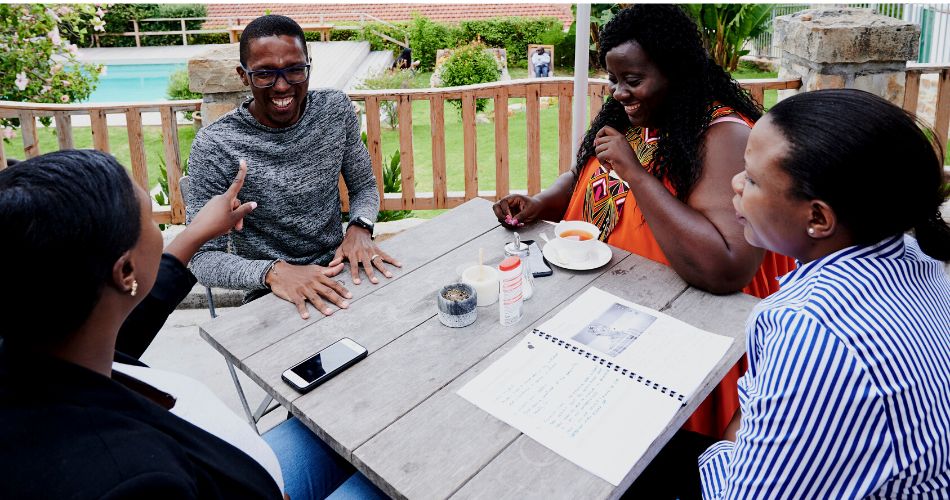
Hardship: for many young people in South Africa, it permeates their daily life, their mindsets and their aspirations. Admitting to the vulnerability that often accompanies such hardship is still a taboo, says Skhumbuzo Mpisane, acting CEO of enke: Make Your Mark, a youth development organisation. But it is this very vulnerability and hardship that Skhumbuzo considers an essential ingredient in the creation of resilience and true leadership among young people. This leadership harnesses the power of resilience and grit which, in turn, emerge from the ashes of hardship.
Lessons in hardship: Growing up in Umlazi
“I did not typically belong,” explains Skhumbuzo, “in the context of the township that I grew up in.” Defining himself proudly as “weird,” Skumbuzo recalls the pressure to fit in among young people in his neighbourhood, Umlazi, in Kwa-Zulu Natal. ‘Masculinity’ and ‘strength’ were defined on the streets and young men were expected to adhere to these definitions – sometimes with harmful consequences. “For example, the majority of young black men there were raised by women, but when engaging with their partners or girlfriends they do the very same things that we all hated about our missing fathers,” he explains. “It was difficult to bring this up with the guys, because you were perceived as weak in doing so.”
Skhumuzo’s introverted observations led him, perhaps, to question these realities that were presented in front of him. As a teenager, Skhumbuzo was influenced by friends who went to former ‘white only schools’ and what he watched on the television. “I always felt that there was more to life than what was available in my environment. I have always been curious and wanted to explore beyond my then current boundaries.
This exploration led Skhumbuzo to apply to study at university – which was unbeknown to his mother and grandmother, who raised him. “I lied to my mother and said that I was only on a waiting list for University of KwaZulu Natal, Howard Campus which meant I’d continue living at home,” he recalls. “My mother did not want me to go away to study. I think she was scared of me leaving the nest.” Despite this, and driven by the innate desire to question the boundaries placed on him, Skhumbuzo left for the University of KwaZulu Natal.
From introvert to extrovert
Attending courses on ethics, law and psychology, Skhumbuzo became fascinated in “how the mind works.” He immersed himself in an academic environment where “debating ideas was expected from you – as opposed to at school, where teachers told you what information to absorb”. But life at university was not always easy; Skhumbuzo applied for various financial grants and worked part-time during holidays to stay afloat. He graduated with a Bachelor of Social Science, majoring in Psychology and Law and, buoyed by a refreshed mindset, he headed back to Umlazi.
“I left Umlazi an extreme introvert, and I came back an extreme extrovert.” Skhumbuzo got to work, starting as a paralegal and then a mediator at the local magistrate court, Skhumbuzo began to explore more deeply the realities facing those living in the neighbourhood.
Within a few years, the city lights were calling, and he moved to Johannesburg, taking a position at enke – where he is now the acting CEO. One group that enke works with is young people who are not in education or training. Shockingly, 42% of South Africa’s youth fall into this category – which equates to over six million young people. By running both responsive and preventative programs, enke uses asset based training and support to activate, inspire and sustain economically active, socially responsible citizens.
How can we scale? A question for the Innovation Fellowship
Since 2009, enke has trained just over 6,000 young people. The impact is sizable – but Skhumbuzo wanted to explore how enke could reach more young people.
Cue the DGMT Innovation Fellowship – in which fellows work through a central question that pertains to their organisation. “So it was perfect, because we came to the Fellowship with that very question – how can we scale our impact?”
Skhumbuzo completed the Innovation Fellowship in 2020, and walked away with a fresh perspective on running an organisation like enke. Central to this was the understanding that investing in the organisation’s employees and encouraging their self-care is directly linked to programmatic impact. “People who work in our sector tend to lack resources to capacitate themselves or care for themselves, as all the resources are directed towards our beneficiaries. So, unconsciously, we neglect ourselves.
The Fellowship helped us build the capacity of our team in a very focused way, which in turn impacts our beneficiaries.”
Capacitating people requires exploration of one’s self – and it was here that Skhumbuzo started to realise that resilience and leadership is not crafted from ‘brute strength’ – but rather from learnings based on the survival of hardship and vulnerabilities in one’s past. “On the Fellowship, I engaged with other men who were also embracing their vulnerability. It was eye-opening because … you then start to engage with the world differently and you start to change your future responses. If you embrace this vulnerability, it is liberating.”

Implementing Fellowship learnings in enke
Between immersive workshops, fellows on the Innovation Fellowship are encouraged to implement their learnings in their own organisations. “I came back to enke and shared my learnings with the team.” Through exploring questions of team members’ self-growth and resilience, the organisation came to see that their programmes had to be more collaborative with beneficiaries in order to be able to be scaled. “Our programmes became more about partnership than just implementing a project on a group of people,” he explains. Skhumbuzo led this process, armed with a fresh understanding of what it is to be a leader.
“Before the Fellowship, I thought that leaders had to know everything about their field. The Fellowship turned that perception around. Leadership also involves accepting when you do not know, and requesting discussion and consensus from the team … This comes back to the idea of vulnerability.”
True grit: threading learnings into programmes at enke
enke runs various programmes that grow and nourish leadership and employability in youth. The Trailblazer+ Programme, for example, works with young people over 9 months, supporting them to design and run Community Action Projects and School Action Projects. What makes these programmes successful – and what will make them scalable, ultimately – is their sensitive approach to developing beneficiaries’ self-worth.
“Society sees young people as something that needs to be fixed. But we ask them what role they can play in improving their situation.” Supporting youth to reconsider themselves is critical. “We don’t say to young people, ‘if you don’t have a matric, you must go back to school and get one’. We work with them to see the options in front of them based on their current abilities.” Skhumuzo stresses that working with young people on their mindset, first and foremost, is what makes the programmes successful. In the Catalyst Programme, for example, the “Reboot” section, which forms the first and longest part of the programme, is the most critical. “We are working with young people who have been unemployed for a long time and have now got into a space of being hopeless,” he explains. “So we need to spend a lot of time on trying to shift their mindset so that they can see opportunities around them.”
Changing mindsets requires the groups of youth to dig into themselves and their pasts, which can be difficult sometimes. Done in a supported and facilitated way, it can liberate them to take new paths. “From there onwards, their trajectory is completely different.”
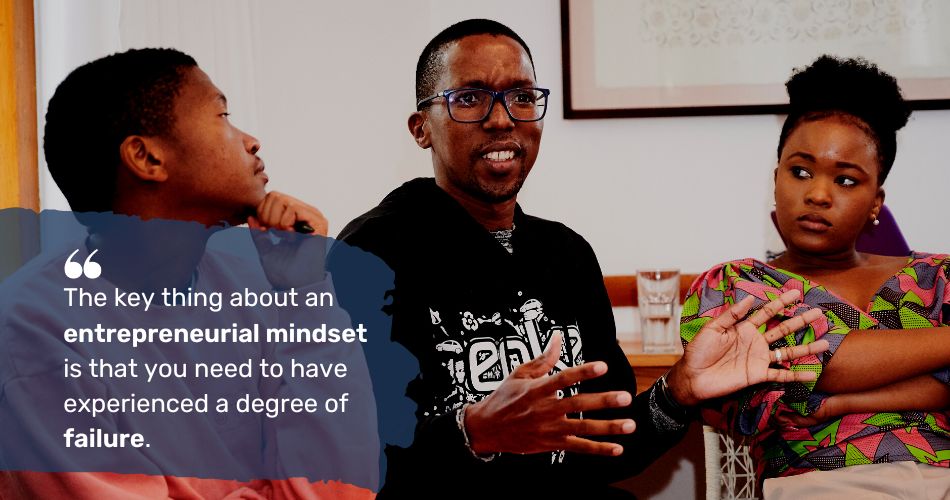
At the centre of this programmatic web is the central belief in developing young people’s grit and entrepreneurial mindset – ‘grit’ being the resolve, courage and strength of character to persist and persevere in the face of adversity. Within this, failure is considered useful, not problematic. This turns the conventional approach to failure on its head. “The key thing about an entrepreneurial mindset is that you need to have experienced a degree of failure, because it helps you to define what it is you can do and what you want. Building grit is important for us because these young people can apply it not only in their work, but also their life,” says Skhumbuzo.
Skhumuzo has grit – in heaps.
Perhaps it is rooted in not always ‘belonging’ during his childhood, and how that resulted in him questioning social boundaries, and later working his way up to acting CEO of an NGO. Either way, his grit comes from an ability, crafted over the course of his life, to shift mindsets in the face of adversity.
The Innovation Fellowship has cemented a connection between hardship, vulnerability and resilience – and it is now woven into enke’s programmes, ensuring their relevance and true impact on young people. “I want to keep creating change,” says Skhumbuzo. “We might not figure it out before we start implementing/scaling our impact. “I learnt in the Fellowship that we might not have all the answers, but that does not stop us from trying to scale our impact and moving forward. We might be in the ocean already, but we just have to keep building the boat around us to sail forward.“