
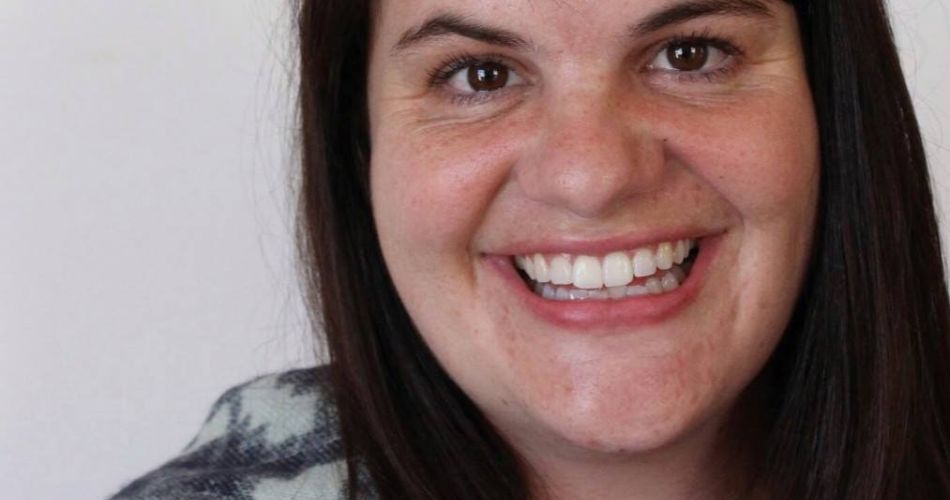
Jeanne Bodenstein – an Advocacy Specialist at Rape Crisis – completed the DGMT Innovation Fellowship in 2018. Her reflections from this have shaped her approach to advocacy work – many of which emanate from her own personal development and realisations.
Roots of advocacy
Advocacy – a process which works to change attitudes, laws and power systems to achieve positive change – can take different forms. It might be litigation, lobbying, campaigns, community mobilisation or media exposure – but at the centre of it all are those who are being advocated for. Indeed, the word itself comes from the Latin advocare, which is to ‘call to one’s aid.’ In other words, the meaning centres around the people who are seeking the assistance – not the one providing the assistance itself.
Extrapolate this to the South African context, and apply this to addressing Sexual and Gender-Based Violence (SGBV), and the question arises: how can we move between individuals’ and societal realities in a way that honestly advocates for survivors of SGBV? How can we make sure that this is done in a way that acknowledges dynamics of power and privilege?
These questions are in the minds of many people working in the South African social justice sector. Jeanne Bodenstein, Advocacy Specialist at Rape Crisis, is one such person – and her experiences during the DGMT Innovation Fellowship in 2018 have helped refine her thinking on this.
Roots of advocacy
Rape Crisis – which was established in 1976 to provide counselling to those affected by rape – is a nationwide organisation that works to ‘promote safety in communities, to reduce the trauma experienced by rape survivors, to encourage the reporting of rape and to work actively to address flaws in legislation.’ Jeanne’s work centres on using advocacy as a means to achieve this end.
Her personal and professional development has followed an interesting trajectory during which unexpected events have carved an intricate understanding of advocacy. Reflecting on this, an image of social issues as three concentric circles emerges – the individual person at the centre, that person’s ‘group’ as the second circle (be it their community or category) and the largest, third sphere of ‘society’ encircling the person and their ‘group’.
In some ways, Jeanne’s career itself can be seen as a journey from the inner to the outer circle of this diagram. Having grown up in contexts where “there was no activist or social justice language used at all,” Jeanne’s dedication to the social justice sector began only when she undertook her articles, after completing a degree in law in 2012.
Here, at the law clinic linked to the University of Stellenbosch, her work focused on assisting individuals – mainly those who had been unlawfully evicted from their homes. Jeanne reflects on how, through the individual experiences of her clients, she was able to see a wider picture of systemic injustice.
“I felt very overwhelmed because of the immense injustice faced by these clients … which was compounded by a system that was immensely unfair.” Jeanne also reflected this image against herself: “My whole life up until that point, I thought that my life was “middle class” and that meant that immense poverty was an outlier. It was a wake-up call to realise that [my situation] was actually an exception.”
Moving into the next circle of social justice
Largely due to financial reasons, Jeanne’s career took a brief stop-over in the world of corporate retail law. This only served to crystallise her desire to work in social justice – partly thanks to habitual workplace misogyny – and from there, her work started to creep into the second concentric circle of advocacy. Jeanne began working on matters that pertained to groups of people rather than individual clients. She became a junior attorney at the Women’s Legal Centre, working on their Sex Work Project, which sought to decriminalise the profession through both individual casework and wider advocacy efforts.
Jeanne understood that her desire for wider systemic change and her legal skill-set were best placed in the “outer” concentric circle. In 2016, she joined Rape Crisis. Here, her work is around developing and implementing advocacy strategies for survivors of sexual violence in South Africa. From this perspective, advocacy is undertaken on a societal level, which ultimately works its way back into the inner circle, improving the reality of individuals on the ground. “Broadly speaking,” Jeanne says, “it is about making change by challenging existing social or legislative systems in order to get a better result for those individuals that have to interact with the system.”
How, though, does a wider advocacy strategy make sure that it is taking its instruction from those very individuals who are affected? This was a central question for Jeanne – and the DGMT Innovation Fellowship had a role to play here.
Taking instruction from the people
When joining Rape Crisis, Jeanne worked on an advocacy strategy to establish Sexual Offences Courts across South Africa – specialised courts that deal specifically with sexual offences and provide special support services to rape survivors. The project was successful, in that these courts were established and are now up and running. However, there was “never really organisational buy-in for the aim of the campaign,” says Jeanne, “because it was felt that it did not serve the needs of our clients – the organisation wanted to focus on what happens before a client gets to the court, what happens right after rape. I learned very quickly that the first focus of advocacy is within my own organisation. I had to convince my colleagues that sexual offences courts were a necessary change in the system.”
The second advocacy project has learnt from this process. “The current advocacy goal is around access to care for rape survivors immediately after rape,” explains Jeanne, “and this was a demand that was much more aligned with the demands of the clients themselves.”
n this way, an advocacy strategy was developed by moving from the “inner” concentric circle outwards, planning how societal and legal change can remain sensitive to the individuals affected.
This sensitivity around advocacy has been influenced greatly by Jeanne’s own understanding of power, privilege, race and inequality.
Understanding privilege to improve advocacy
“The Innovation Fellowship was probably one of the most life-changing experiences that I have ever had,” Jeanne explains. “It really helped me to verbalise, tear apart, analyse and put back together how I think about race, privilege, South Africa, and education. There were times that I felt extremely vulnerable, but it was also a place where I really felt safe. It was a journey for me to accept that I am an educated white woman with a lot of privilege who does want a better South Africa, and that I can be part of that without being less, without staying small, but at the same time, really making sure that I claim and own my privilege in a way that allows other people to feel more powerful.”
This journey was to have a great impact in her work. Professionally, Jeanne stands inside her own inner circle, around which are concentric circles of advocacy work around SGBV, social justice and inequality – in turn, affecting many other people, especially those affected by these issues. Her own personal processes have ramifications for the work she undertakes.
Before,” says Jeanne, “there were times when I felt shame. I had to “play small” to make space for other people. But by the end of the Fellowship – and what I try to do in my professional career at the moment – I try to acknowledge when I may hold more power than someone else in the room. We are not allowing others to own and assert their voice more by being silent.” Learning how to acknowledge privilege and power whilst encouraging others to use their voice has been critical to Jeanne growing a more inclusive – and wider-impacting – advocacy approach.
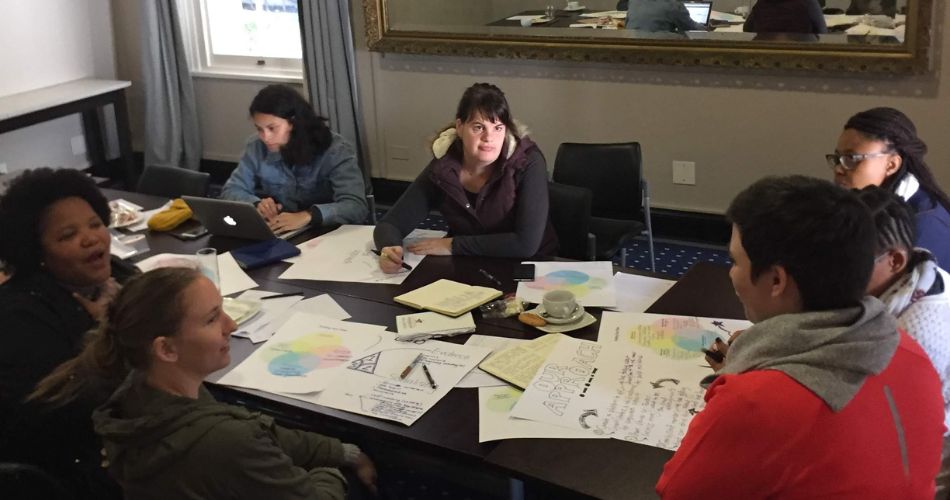
Interestingly, this topic was not a “formal module” of the DGMT Innovation Fellowship, but it rather took place “at the dinner table, at breakfast, or while socialising” with the other Fellows – who came from a range of different civil society organisations.
Indeed, the personal developments that Jeanne gained informally from the Fellowship ran alongside the “formal” question that Jeanne and her colleague, Zeenat Hendricks, brought to the Innovation Fellowship, which looked at how to create financial sustainability at Rape Crisis. The Fellowship “helped Rape Crisis to be more open to external influence” and played a part in the sustainability strategy that was undertaken by the organisation shortly after the Fellowship.
Shape-shifting realities
The Fellowship formed an important part of Jeanne’s ongoing journey in acknowledging privilege and power. “It has helped me to challenge the norms in my own social circles, too,” she says.
“I want a better South Africa, and I can be part of that without being less of who I am,” she says. “I can use my education and resources wisely and with understanding of our social context and socio-economic reality.. I can use and own my privilege in a way that allows other people to feel more powerful.”
The complex intersection of personal, professional, individual, society, power and powerlessness evokes a different image of advocacy: not of concentric circles anymore – but rather one that remains interconnected, however much the shapes shift around. Perhaps it is a kaleidoscope, rather.